
All Calcium is not created Equal
All Calcium is not created Equal
Did your mother constantly tell you, ‘Drink your milk; it has lots of calcium.’ Mine sure did.
Calcium is such an important element. A life without calcium would be extremely difficult, as our teeth and entire skeleton is made from it. Without calcium, we wouldn’t be able to walk, move our arms, or chew our food.
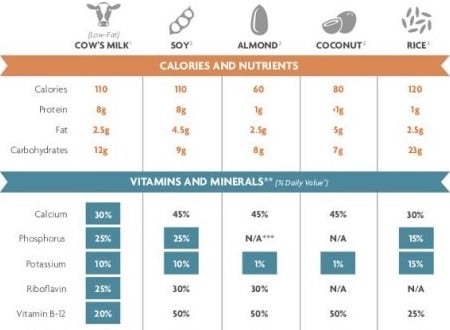
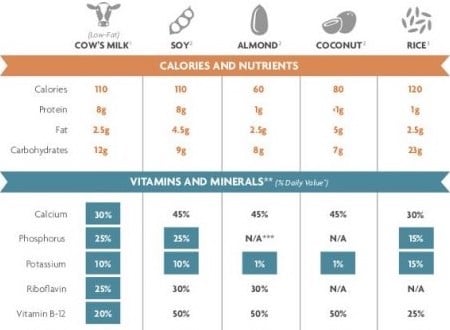
Recently, the National Dairy Council publicized a “What’s in your glass” schematic of dairy milk versus soy, almond, coconut and rice beverages. Three of the four non-dairy beverages all had exactly 45% of the daily recommended amount of calcium; dairy only had 30% of the recommended amount.
This seemed odd to me, so I began to research and uncovered that not all calcium is created equally.
Here’s why.
Calcium is naturally occurring in dairy milk. The dairy industry also fortifies some types of milk with vitamin D, which aids in the assimilation of the element into our bodies. As the cow eats a perfectly balanced ration of highly nutritious silage, grains, hay and assorted commodities, the bacteria in her stomachs breaks the calcium down and it is absorbed into her blood stream.
After pregnancy, her lactating mammary glands pull the calcium out and add it in high quantities to her milk to support the growth of her baby as calcium hydrogen phosphate, CaHPO4. The CaHPO4 is a molecule that is homogenously mixed and readily available for immediate absorption. It does not come out of suspension and immediately can be assimilated by the human or baby cow body.
By contrast, when tree nuts, oats and rice are squished into liquid beverages, the naturally occurring amount of calcium is around 1-8%. The exception is soy, which is 51%. These beverage producers have to fortify the beverage with calcium to continue to market it as dietary dairy milk replacement, so they add powdered chalk to it. That’s right. Chalk. Like the chalk teachers once used to write on the blackboard. Another name for it is calcium carbonate.
In these non-dairy beverages, after a few days the calcium begins to sink to the bottom of the carton. After a week or two when you finally get to the last glass, the calcium is the chunky stuff you feel on your tongue as you drink it. More important, most of the calcium carbonate gets obliterated by the acid in your stomach, being converted to CaCL2 and thus is not fully absorbed into the body. CaCL2 is what is used to melt ice on your driveway in the winter
Consumers need to understand what they are reading when these nutritional guides are published and have a clear understanding of what they are putting into their bodies. Most people drink these alternative beverages because of the perceived health benefits, but they end up not getting the nutritional benefit for which they paid for.
Clearly, all calcium is not created equally.

By Brett Roeller
Director of National Accounts, QualiTru Sampling Systems
brett@qualitru.com Follow Brett on LinkedIn
By contrast when tree nuts oats and rice are squished into liquid beverages the naturally occurring amount of calcium is around %. The exception is soy which is 51%. These bevera